Nikon Z5II vs Z7II vs Z6III vs Z8: A Working Pro’s Real-World Comparison

Which Nikon camera is right for you in 2026?
In this Nikon Z5II vs Z7II vs Z6III vs Z8 comparison, I’ll share my honest, real-world experience with three of these four cameras as a working professional photographer based in West Cork, Ireland. I own and shoot professionally with three of these four Nikon Z-series cameras — the Z7II, the Z8 and the Z6III. I haven’t done a full review of the Z5II yet, but I’ve used it plenty on workshops with clients and out in the field, and it shares the same sensor as my old Z6II, so I know its character very well.
Rather than regurgitate spec sheets, I want to talk about how each of these cameras actually performs in the real world, where they shine, and honestly — where they fall short. By the end, you should have a much clearer idea of which one suits your work.
Nikon Z5II, Z7II, Z6III and Z8 Review : Table of Contents
The Cameras at a Glance
Nikon Z5II
The Z5II gives you 24 megapixels, nine subject detection modes (including birds and vehicles), autofocus down to -10 EV in pinpoint mode, 7.5 stops of in-body image stabilisation, a fully articulating screen, and 4K video with N-Log and N-RAW internal recording. Dual SD card slots, and the whole thing is wrapped in a properly weather-sealed body. For the price, it’s a lot of camera.
Nikon Z7II
I know some of you are already thinking, the Z7II came out in 2020, Kieran — why are we even talking about it? Because in my mind, the Z7II is criminally underrated in 2026. If you’re a resolution-first photographer, it’s still a seriously compelling option, especially at the price it’s sitting at right now.
46 megapixels, dual card slots, amazing dynamic range (yes, better than the Z8 and Z9), solid weather sealing, that gorgeous Nikon handling and ergonomics, and a price that has dropped meaningfully since launch. It’s not the fastest and it doesn’t have the newest autofocus systems — but for the right photographer, in the right genres, it remains absolutely class-leading even today. The images this camera produces are truly stunning.
Pair it with the Z 14-30mm f/4 S or the Z 14-24mm f/2.8 S for landscape work.
You can read my full Nikon Z7II review for more details.

Nikon Z6III
The ultimate all-rounder. This one is interesting because it does so much so very well. 24 megapixels on a partially stacked sensor, the Expeed 7 processor, a class-leading EVF at 5.76 million dots running at 120 Hz, a fully articulating screen, and autofocus that can almost keep up with the Z8 and Z9.
My Z6III has become my go-to second body and gimbal camera. It’s lighter than the Z8, incredibly versatile, and the image quality is genuinely stunning. The partially stacked sensor does have a slight dynamic range trade-off versus the Z5II, Z7II and Z8 — but for most photographers, that’s simply not going to be a deal-breaker.
You can read my full Nikon Z6III review for more information.
Nikon Z8
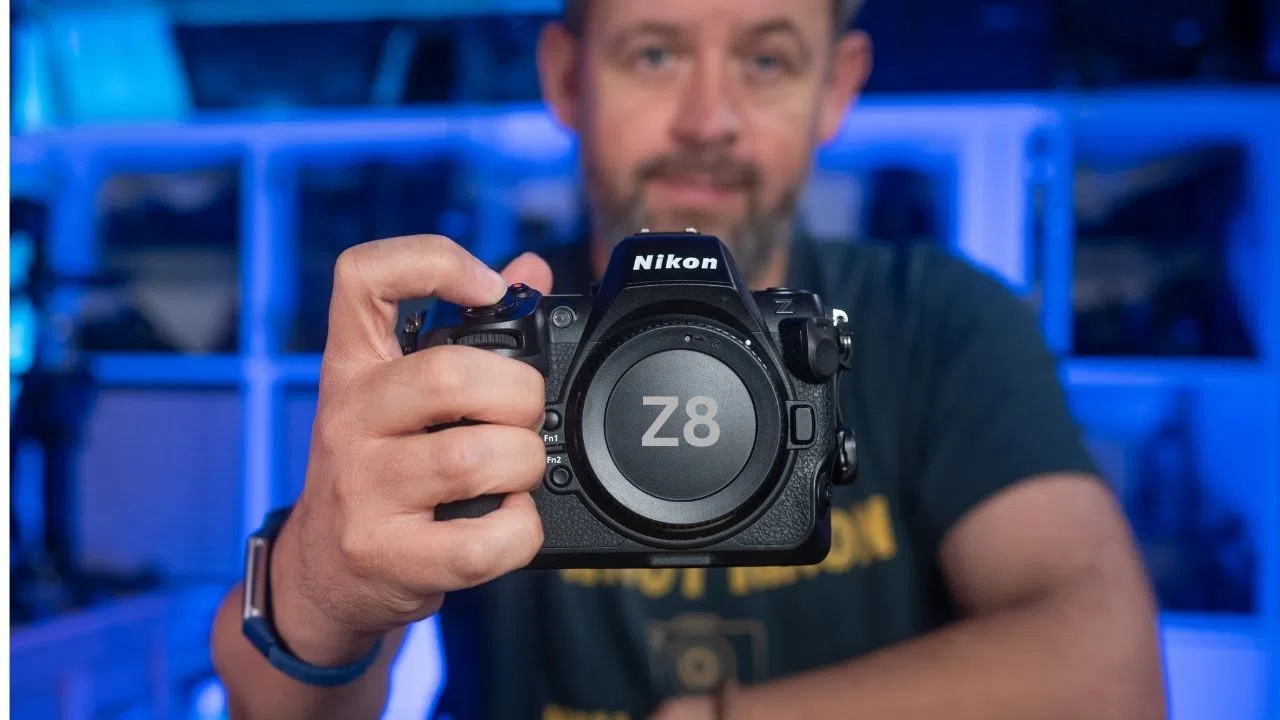
The near-flagship. My main camera. The one I reach for every time I head out on a commercial shoot or a portrait session. 46 megapixels on a fully stacked sensor, no mechanical shutter, 20 frames per second RAW, 8K video, class-leading autofocus, illuminated buttons, rock-solid weather sealing. On paper, it’s the best camera of the four.
It’s also the most expensive by far, and it’s bigger and heavier than the other three. For some photographers, the extra performance is performance they’ll genuinely never need or use. Just because it’s close to being a flagship doesn’t automatically make it the right choice for you.
You can read my full Nikon Z8 review and find all the juicy specs on it.
| Spec | Z5II | Z7II | Z6III | Z8 |
|---|---|---|---|---|
| Resolution | 24MP | 46MP | 24MP | 46MP |
| Sensor | BSI-CMOS | BSI-CMOS | Partially stacked | Fully stacked |
| Processor | Expeed 7 | Dual Expeed 6 | Expeed 7 | Expeed 7 |
| Max burst (RAW) | 14 fps | 10 fps | 20 fps | 20 fps |
| Max video | 4K 60p (1.5x crop) | 4K 60p (1.5x crop) | 6K 60p N-RAW | 8K 60p RAW |
| EVF | 3.69M-dot 60Hz | 3.69M-dot 60Hz | 5.76M-dot 120Hz | 3.69M-dot 120Hz |
| IBIS | 7.5 stops | 5 stops | 8 stops | 6 stops |
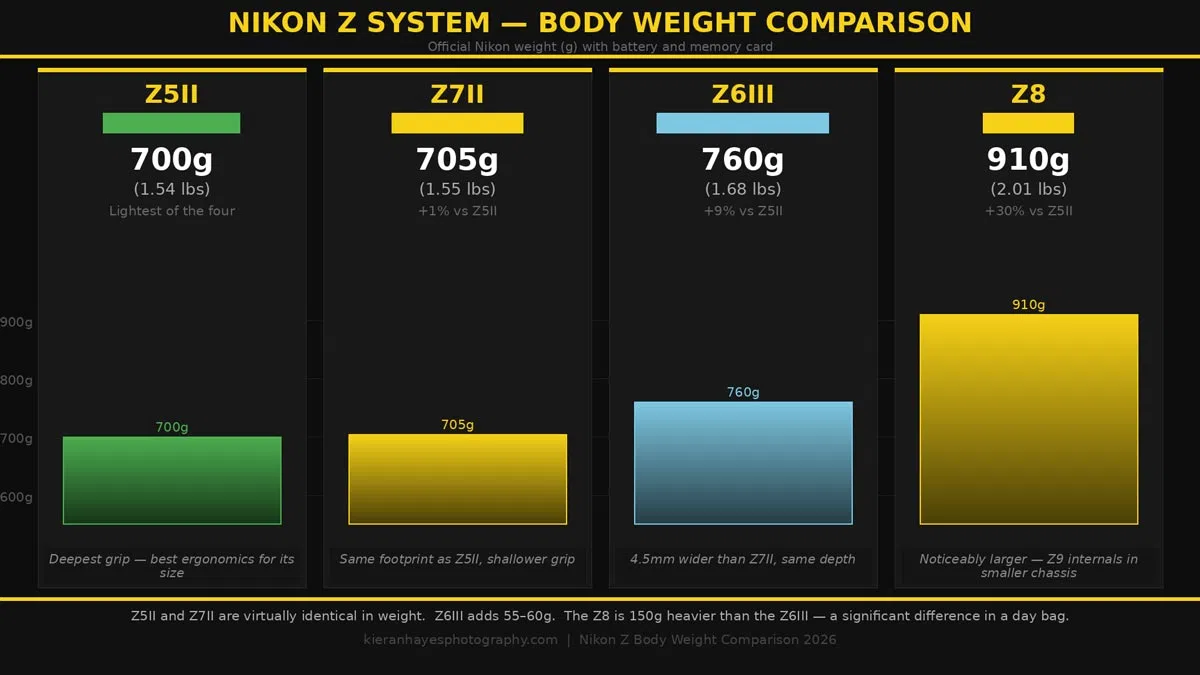
| Weight (body) | ~700g | ~705g | ~760g | ~910g |
| Approx. price (USD) | ~$1,700 | ~$2,000 | ~$2,500 | ~$4,000 |
Resolution: 24MP vs 46MP
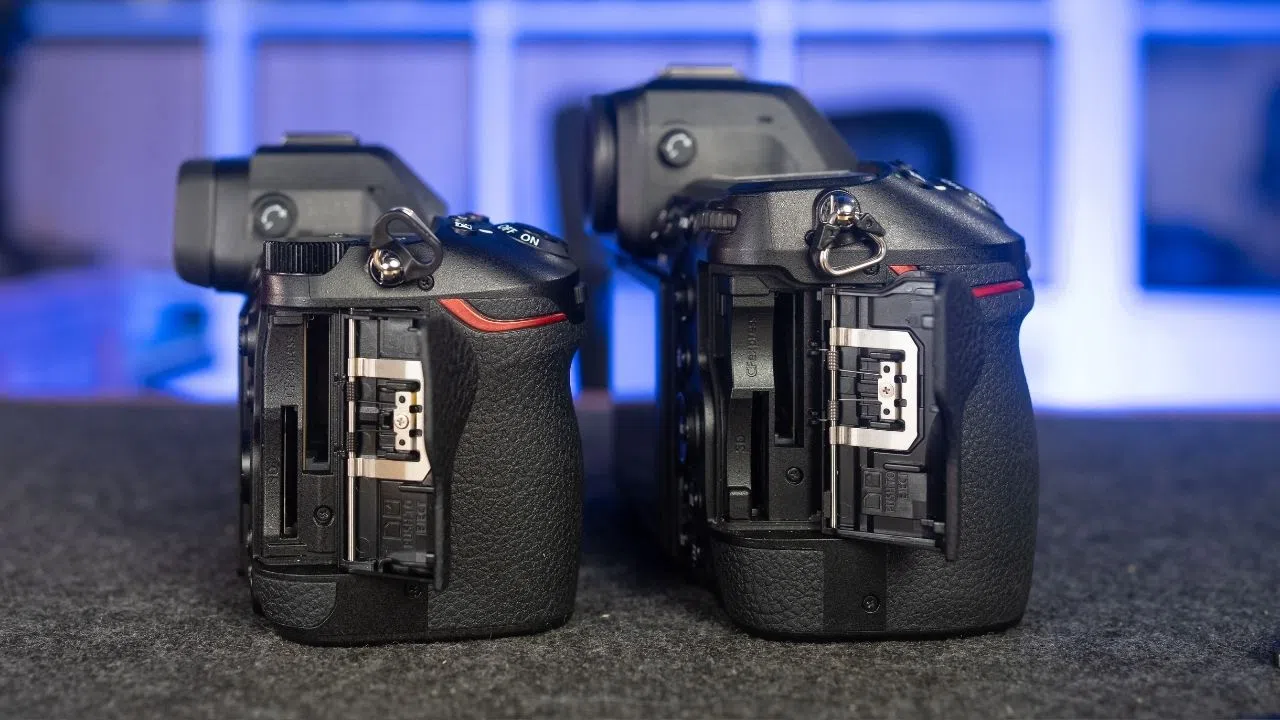
The Z7II and Z8 are both 46 megapixel cameras. The Z6III and Z5II are both 24 megapixel. So does resolution split this cleanly into two camps? Not quite — because there’s more to image quality than megapixel count.
24 megapixels is loads for standard prints and normal use. It genuinely is. 46 megapixels gives you more room for really large prints and more cropping headroom in post. For events, weddings, portraits, most landscapes, 24 megapixels is more than enough for the vast majority of photographers.
For serious commercial work — and when you need that cropping safety net — 46 megapixels is a great fallback, but it comes with increased storage costs for both your computer and your memory cards.
Ask yourself honestly: do I actually need the extra resolution? And if I do, what do I need it for? If the answer isn’t clear, a Z5II or Z6III paired with a higher-quality lens may very well be the smarter move.
High ISO and Low Light
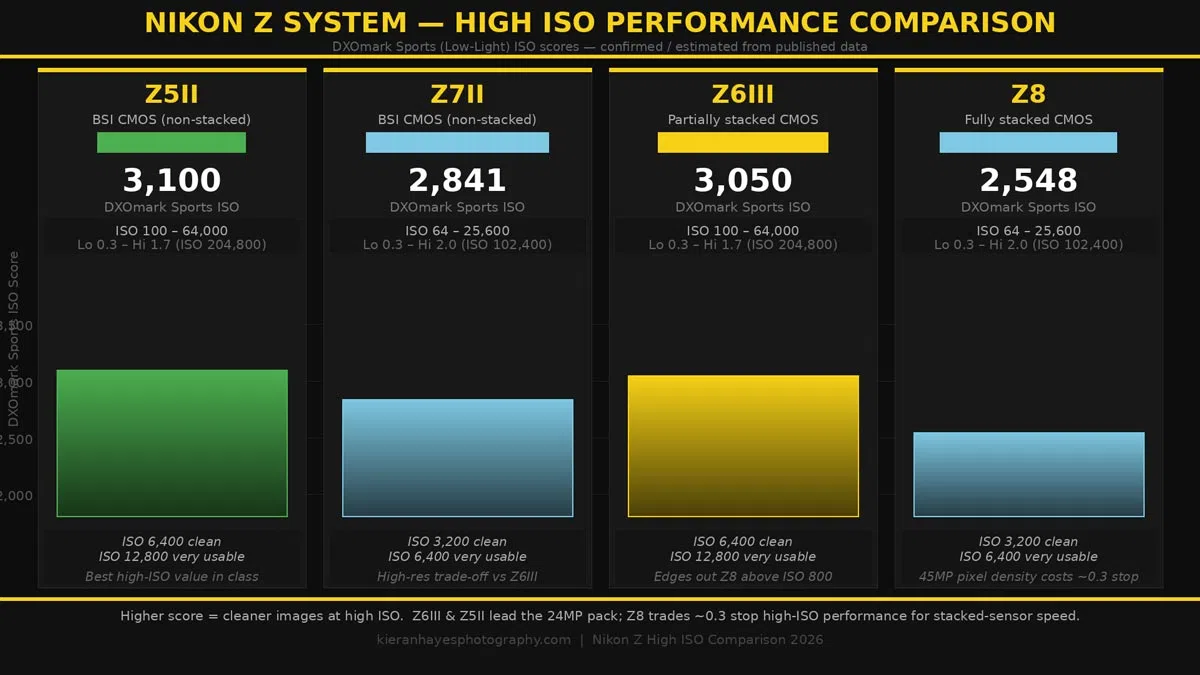
At higher ISOs, 24 megapixel cameras generally have a slight advantage over their higher-resolution siblings, thanks to larger individual pixel sites and better noise handling at the same output size. So for low-light events, available-light portraits, and night photography, the Z5II and Z6III are actually very slightly ahead of the Z7II and Z8.
The Z5II is the overall winner on the high ISO chart with cleaner images. Is it night and day? Absolutely not. I’m only mentioning this so people don’t assume the Z8 is obviously better in low light just because it’s the dearest body in the line-up. In practice, you’ll be hard pushed to see a meaningful difference.

Dynamic Range
This is huge for me personally as a seascape photographer. Looking at the numbers, the Z8 and Z7II lead the way, with the Z5II in third and the Z6III in fourth.
The Z6III’s partially stacked sensor brings genuine advantages, but one of its trade-offs is slightly lower dynamic range in raw files. It’s still very good — don’t get me wrong. The Z5II uses a backside-illuminated sensor rather than a stacked design, and for stills its dynamic range is very competitive in this tier. You’re not getting Z7II or Z8 level shadow recovery, but for most landscape and portrait shooters it’s brilliant.
Between the top two — Z8 and Z7II — you might assume my default landscape camera would be the Z8. It’s not. It’s the Z7II. There isn’t a huge gap, but there’s about half a stop according to Nikon, or nearly a third of a stop according to Photons to Photos. That can be enough in some scenes. When I’m shooting seascapes in very extreme lighting, having the maximum dynamic range I can get is a nice fallback.
Again — the difference is slight. For normal photography, all four cameras have perfectly acceptable dynamic range. But if you regularly push your files hard, the right camera choice matters.
Burst Mode and Buffer Performance
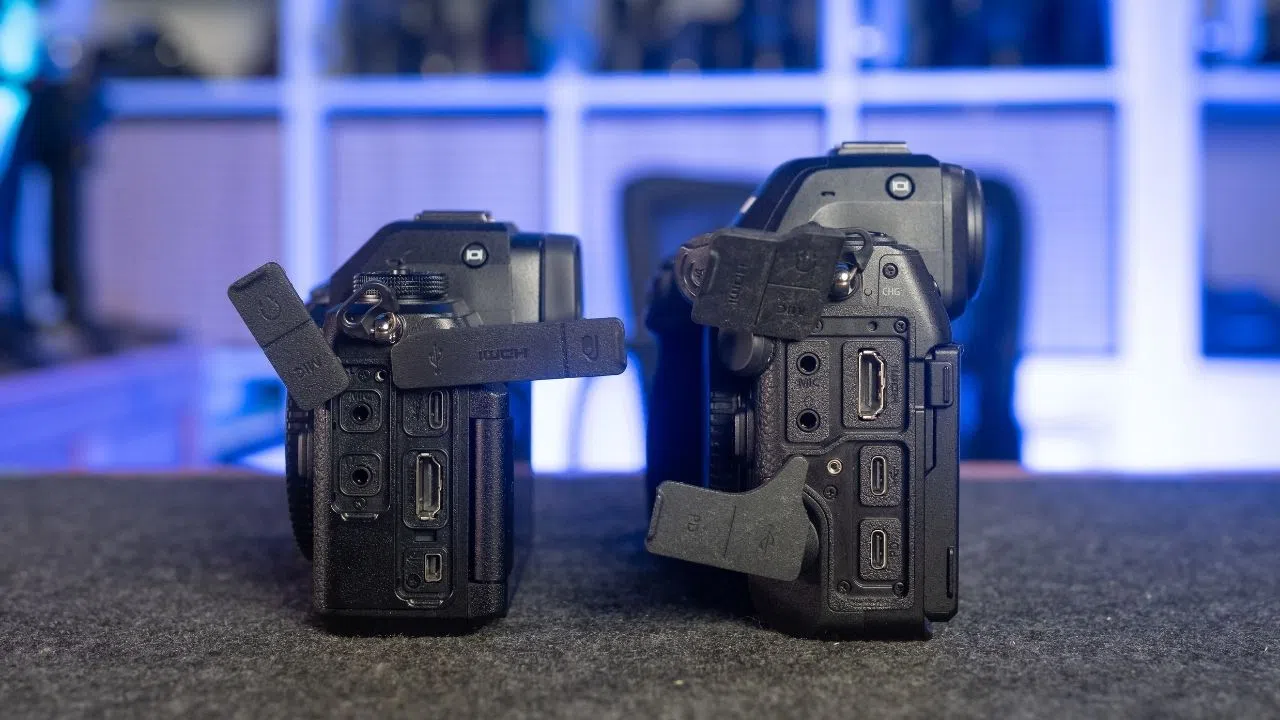
Burst rate is one area where the spec sheet differences are dramatic — and where the older Z7II really starts to feel its age.
The Z8 leads the pack at 20 frames per second in full RAW with autofocus tracking, thanks to its fully stacked sensor and lack of a mechanical shutter. There’s no blackout in the viewfinder either, which means you can actually follow your subject through the burst rather than guessing where it went.
For wildlife, sports and action work, this combination is genuinely class-leading. Buffer depth is also enormous — you can hold the shutter down on a flock of birds in flight and still have headroom left.
The Z6III matches the Z8 at 20fps RAW, which on paper looks identical. In practice, the Z6III uses a partially stacked sensor rather than a fully stacked one, so its blackout-free shooting is a software simulation rather than true zero-blackout.
It’s good — really good — but in a long burst on fast erratic subjects, it’s not as clean as the Z8. For most shooters, you won’t notice. For serious bird-in-flight work where every frame counts, you will.
The Z5II is the surprise here. It hits 14fps in RAW with the mechanical shutter, and up to 30fps in JPEG using the electronic shutter. For a camera at this price point, that’s remarkable.
Buffer depth is more modest than the Z8 or Z6III — you’ll fill it faster on extended bursts — but for the vast majority of photographers shooting occasional action, it’s more than enough.
The Z7II brings up the rear at 10fps in RAW, and you’ll feel the older buffer fill quickly when shooting 46MP files. The viewfinder also blacks out between frames, which makes tracking erratic subjects considerably harder.
For landscape, portrait and studio work this doesn’t matter at all — but it’s another reason the Z7II isn’t the camera to reach for if action is a regular part of your work.
If burst speed and buffer depth genuinely matter to you, the order is clear: Z8, then Z6III, then Z5II, then Z7II. If you mostly shoot single frames or short two-or-three-frame bursts, the differences fade away and any of the four will keep up with you.

Autofocus
This is where things get interesting. Conventional wisdom says the Z8 has by far the best autofocus, and yes — its subject tracking, bird detection and 3D AF is truly exceptional. For sports, wildlife, fast-moving and unpredictable subjects, it’s absolutely brilliant and very sticky.
The Z6III and its partially stacked sensor has great autofocus too. The 120 Hz EVF (5.76 million dots) makes tracking moving subjects that bit smoother, and for portrait and event work in difficult light, the Z6III is actually a bit more responsive than the Z8. In normal lighting, though, the Z8 is faster and remains the better option.
The Z5II is genuinely impressive considering the price. Same Expeed 7 processor, nine subject detection modes including birds, and low-light AF down to -10 EV (in pinpoint mode). The Z6III is slightly better still for those low-light scenarios, and the Z8 is clearly ahead in bright daylight. But for the vast majority of photographers, the Z5II’s AF is brilliant.
And then the Z7II — this is where the biggest gap shows. It works well in daylight and for portraits in decent light, but for low light, fast action, wildlife or anything unpredictable, it shows that it’s a generation behind the other three. The AF king is the Z8, with the Z5II and Z6III close behind.
Size, Weight and Handling
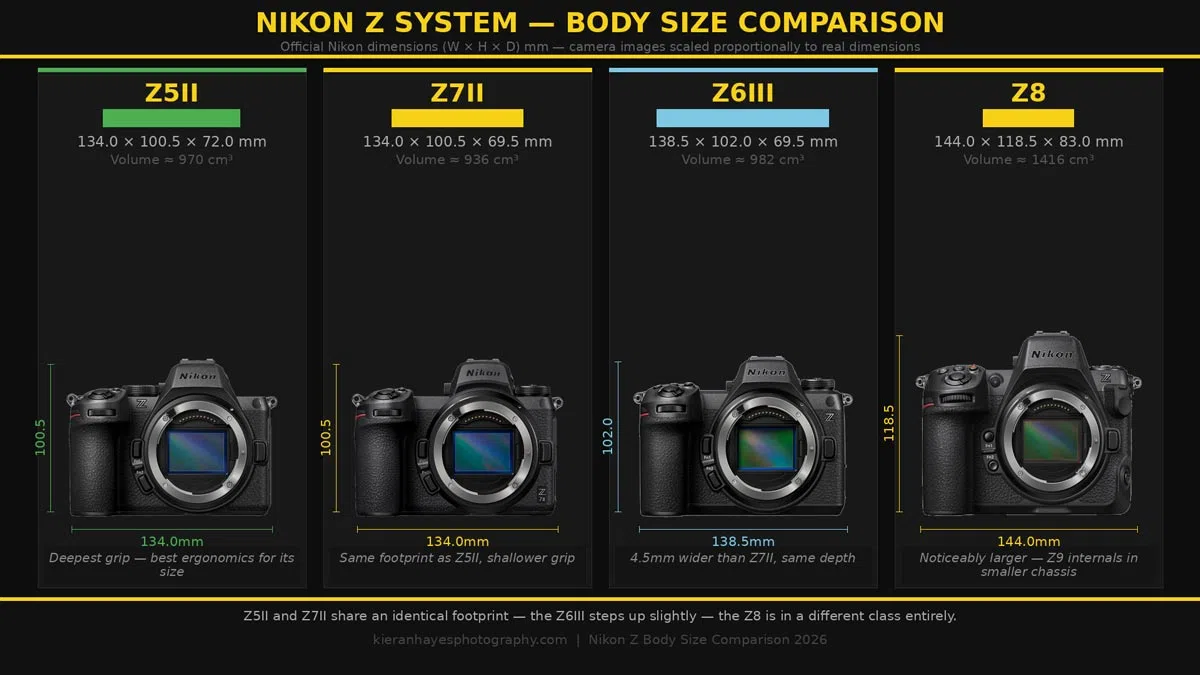
The Z8 is the biggest and heaviest. It’s a substantial camera, but it’s not enormous — significantly smaller than the Z9. It balances beautifully with bigger lenses and the deep grip is comfortable for long shoots, but if you prioritise travel-friendly kit or spend a lot of time on a gimbal, that weight adds up.
The Z6III is noticeably lighter and more compact — about 150g lighter than the Z8, narrower and shorter. The Z7II and Z5II are very similar in size, both smaller and lighter than the Z6III.
If you handhold a lot and want a substantial body that balances well with larger lenses, the Z8 is truly great. The Z6III isn’t too bad either. If you want something small and light you can carry all day, look at the Z5II or Z7II.
Video
The Z8 is the video powerhouse — 8K RAW 60p, 4K up to 120fps (cropped), 12-bit log, ProRes RAW. If you’re a serious hybrid shooter or professional videographer, it’s one of the best video cameras in its class.
The Z6III — which I’m recording on — is excellent too. 6K 60p, 4K 120p, 12-bit N-Log, ProRes RAW. For corporate, social content, YouTube and short films, it delivers genuinely great footage. The lighter weight and articulating screen also make handheld and gimbal work much easier.
The Z5II has surprised a lot of people — full-frame 4K up to 30fps, 4K 60p with a 1.5x crop, 1080p at 120fps, 12-bit N-RAW internally to an SD card. Rolling shutter in 4K is more noticeable than on the Z6III and Z8 due to slower sensor readout, so it’s not ideal for fast panning shots.
The Z7II is the weakest of the four for video by a clear margin. Its 4K 60p is cropped at 1.5x, full-frame tops out at 4K 30p, and there’s no RAW video. Quality is good enough, but codec flexibility is limited and rolling shutter is the most pronounced of the group.

Value for Money
The Z5II is the most affordable, and frankly, it’s astonishing value. The Z7II comes next — 46 megapixels and a professional build for significantly less than the Z6III or Z8 — and that makes it a pure bargain right now in my eyes. The Z6III sits in the middle, roughly 60% of the cost of the Z8, and for what it delivers that’s very good value. The Z8 is the dearest and has to justify itself for your specific shooting needs. For me, it does.

Who Should Buy What
Here’s how I’d match each photographer to the right camera in this Nikon Z5II, Z7II, Z6III and Z8 lineup…
For landscape and studio shooters
If you shoot largely from a tripod, value maximum image quality and dynamic range, and autofocus speed isn’t your top priority, the Nikon Z7II deserves serious consideration. It’s a bargain. Dynamic range is excellent, resolution matches the Z8, and the colours out of this camera are gorgeous. If your budget can stretch, the Z8 is the best all-rounder you can get — and the Z 14-24mm f/2.8 S or Z 24-70mm f/2.8 S II are stunning companions for either body.
For portraits, weddings and events
If you’re moving around, shooting people in challenging mixed light, and autofocus reliability is critical, I’d point you firmly at the Nikon Z8 if your budget can afford it. It’s built like a tank and that reliability matters when you’re paid to deliver. If not, the Z6III or even the Z5II will serve you well — newer AF and better subject detection blow the Z7II out of it for this kind of work. Pair with the Z 85mm f/1.8 S or Z 70-200mm f/2.8 VR S II for gorgeous portrait work.
For travel and street
You’re down to three choices — the Z5II, Z7II or Z6III. The Z5II for travel is honestly one of the best options available: lighter body, excellent high ISO, great dynamic range, latest AF systems. And the money saved compared to the Z6III goes a long way toward a better travel lens like the Z 24-120mm f/4 S or the versatile Z 24-200mm f/4-6.3 VR. The Z7II is a strong travel companion too, though I’d have slight concerns about its AF being more troublesome at times.
The Z6III is the more rounded option — if you think you’ll be shooting meaningful video alongside stills, lean towards the Z6III.
For wildlife and sports
The short answer is the Nikon Z8. For fast action, birds in flight, and unpredictable subjects, the combination of 20fps raw, the most reliable subject tracking, the fastest sensor readout, and true hardware-based zero-blackout dual-stream viewfinder is exactly what you want. The Z6III has a blackout-free function too, but it’s a software trick — more strobe-y and not as clean as the Z8’s.
Pair the Z8 with a Z 180-600mm f/5.6-6.3 VR or a Z 600mm f/6.3 VR S and you’ve got a seriously capable wildlife kit.
The Z6III is a more affordable alternative that can surprise you. The Z5II can handle wildlife too, though you’ll feel the 60 Hz EVF and blackout in burst mode. The Z7II struggles for serious fast action, and even more so when light drops.
My Recommended Lenses For Each Genre
Affiliate links — I earn a small commission at no cost to you. Thanks for the support.
Landscape
Portraits, Weddings & Events
Travel & Street
Wildlife & Sports

Frequently Asked Questions
Is the Nikon Z7II still worth buying in 2026?
Yes — for the right photographer. The Z7II is criminally underrated in 2026 if you prioritise resolution and dynamic range over autofocus speed. With 46 megapixels, dual card slots, professional weather sealing and dynamic range that actually beats the Z8 by around half a stop, it’s a serious bargain at today’s prices.
It’s not the camera to choose for fast wildlife or sports, but for landscape, studio, portrait and commercial work it remains class-leading.
Is the Nikon Z5II good enough for professional work?
Absolutely. The Z5II shares the Expeed 7 processor with the Z8 and Z9, has nine subject detection modes including birds, autofocus down to -10 EV, 7.5 stops of in-body stabilisation and a properly weather-sealed body. For weddings, events, portraits, travel and most landscape work it’s more than capable as a primary or secondary professional body — and at the price, it’s astonishing value.
Should I buy the Nikon Z6III or the Z8 for wedding photography?
If your budget allows, the Z8 is the more reliable choice for paid wedding work — its built-like-a-tank construction, illuminated buttons and class-leading autofocus genuinely matter when you only get one shot at the moment. That said, the Z6III is an excellent alternative at roughly 60% of the price, and in difficult mixed lighting its autofocus is actually slightly more responsive than the Z8.
Many wedding photographers run a Z8 as their primary body and a Z6III as their second.
Which Nikon Z camera is best for wildlife photography?
The Nikon Z8. For fast action, birds in flight and unpredictable subjects, the combination of 20fps RAW, the most reliable subject tracking, the fastest sensor readout and true hardware-based zero-blackout viewfinder is exactly what you want. The Z6III is a more affordable alternative that can surprise you for occasional wildlife, while the Z5II can handle it but you’ll feel the 60Hz EVF and blackout in burst mode. The Z7II struggles for serious fast action.
What’s the difference between 24MP and 46MP for everyday photography?
For most photographers, 24 megapixels is more than enough — it handles standard prints, social media, weddings, events and most landscape work without issue. 46 megapixels gives you serious cropping headroom and the ability to print very large, but it comes with bigger files, more storage costs and slightly noisier results at high ISO. Unless you regularly print huge or crop heavily, a 24MP body paired with a higher-quality lens is often the smarter spend.
Final Thoughts
Choosing between the Nikon Z5II, Z7II, Z6III and Z8 really comes down to what you actually shoot…
There’s no single “best” camera here — each one earns its place for different photographers. If your budget is tight and you want a camera that can do almost anything, look at the Z5II. If you shoot landscapes, prize dynamic range, and want 46 megapixels without paying Z8 money, the Z7II is a steal.
If you want the most balanced all-rounder with genuinely great hybrid video chops, the Z6III is hard to beat. And if you need the very best Nikon has short of the Z9 — and your work demands it — the Z8 will reward you every day.
Watch the Full Video and Join Me in Ireland
You can watch my full in-depth Nikon Z5II vs Z7II vs Z6III vs Z8 review video above and see for yourself which one is right for you and why… I have a range of videos like this over on my YouTube channel so make sure to check them out.
If you’d like to shoot with me in person, come join me on one of my photography workshops in West Cork, Ireland — I’d love to see you on the coast.
Thanks for reading, and see you out there.
Kieran