Nikon Z8 Firmware Hack: What It Does and Why I’m Not Installing It (Yet)

A few weeks ago I made a video about the features I wanted Nikon to add to the Z8 in its next firmware update. Open gate, RAW pre-capture and in-camera pixel shift merging were all on the list. Well, somebody has gone and added them. And no, it isn’t Nikon.
A group of independent developers working with AI tools has cracked open the Nikon Z8 firmware and built a patch that does almost everything on my list: 8.3K open gate N-RAW, RAW files in pre-release capture, pixel shift merged in the camera and anamorphic desqueeze too.
I’ll be honest with you. I started a project like this myself and abandoned it, mainly because I was afraid of breaking my own Z8. So I’m genuinely delighted to see this happening, but I’ve also seen a lot of excitement online and not much caution. This article covers what the patch does, how it works, the real risks and what I think Nikon should do next.
What is NikonFirmwarePatch?
The project is called NikonFirmwarePatch. It’s led by one developer with a handful of contributors and version 0.4.0 landed on 10 November 2026. It’s free and open source.
Before you go running off to download it, though: Nikon does not endorse or support it, installing it will very probably void your warranty and there is a genuine risk of bricking or corrupting your camera. More on that below.
None of this takes anything away from the Z8 itself. With firmware 2.0 and 3.0 Nikon turned it into a complete beast. Even in 2026, with talk of a Z8 Mark II in late 2027 or early 2028, it’s fantastic what this camera can do. Credit where it’s due. You can read my full thoughts in my Nikon Z8 review.
How the Z8 firmware hack works
For years Nikon firmware was seen as pretty well locked down. Canon shooters had Magic Lantern. Nikon shooters had nothing like it.
What’s changed is AI. Developers have been using large language models alongside proper reverse engineering tools like Ghidra and camera emulators running on a computer to pull the firmware apart, understand it, patch it and repackage it. Nikon firmware is signed and verified, so the camera would normally reject anything that had been modified. Someone has worked out how to re-sign it. This is part of a wider wave people are calling “vibe-coded” firmware.
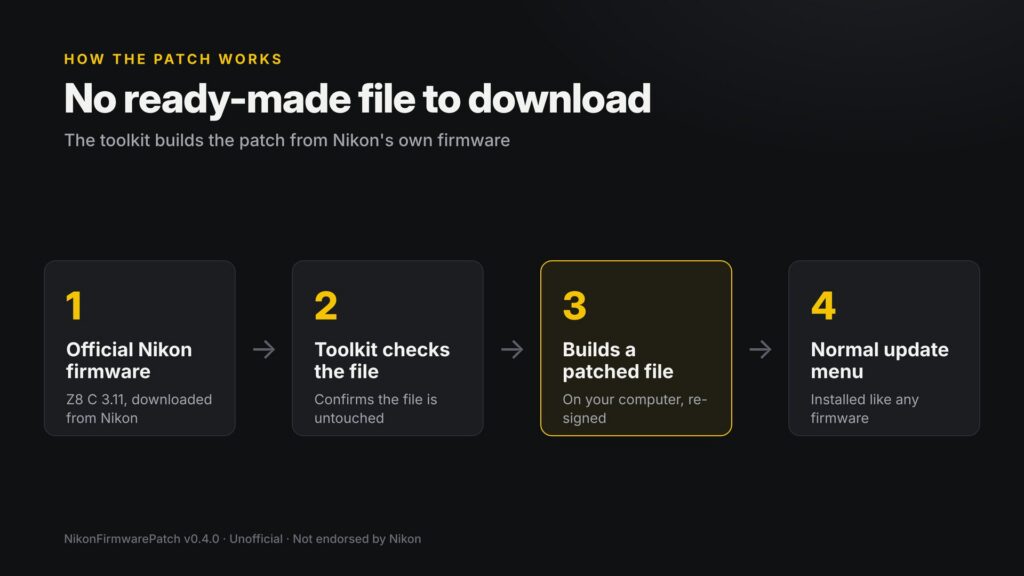
One important detail: you don’t download a ready-made firmware file. The toolkit takes Nikon’s own official Z8 firmware, version C 3.11, checks that it’s untouched and builds a patched version from it on your computer. You then install that through the camera’s normal firmware update menu. Unlike Magic Lantern, nothing runs from the memory card. The patched firmware replaces Nikon’s inside the camera.
What the patch adds
The patch is split into four feature groups (video framing, codecs, log and photo tools) that can be built on their own or in any combination.
8.3K open gate N-RAW
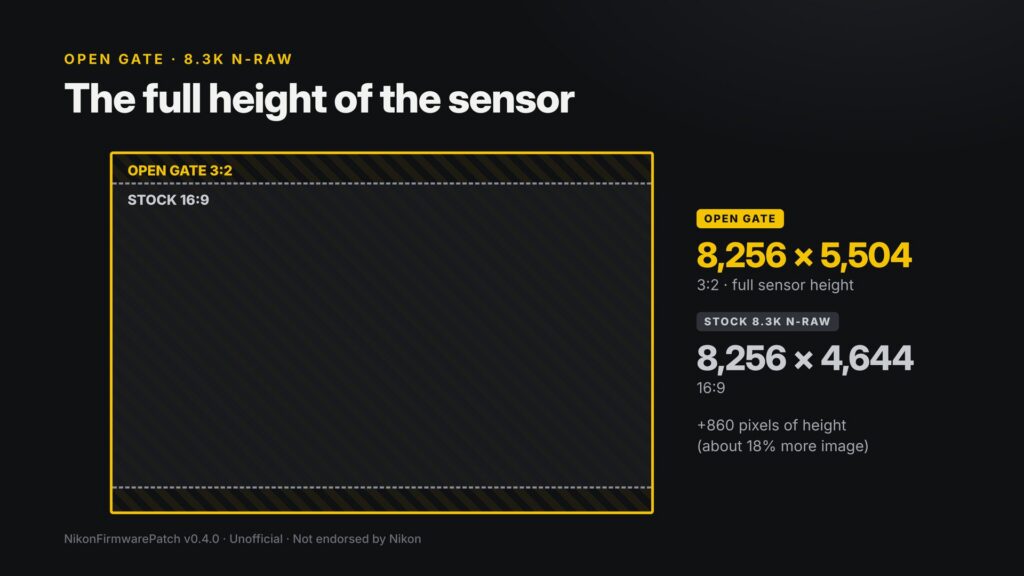
This is the headline. The patch adds full-sensor 3:2 open gate in N-RAW at 8.3K: 8256 x 5504 pixels at 24, 25 or 30p. Stock 8.3K N-RAW on the Z8 is 16:9 at 8256 x 4644.
You get the full height of the sensor, which is great if you want to crop a vertical or square clip from the same recording and still have your landscape version. There are limits right now. There’s no 50p or 60p in open gate, and ProRes and H.265 stay 16:9, so this is N-RAW only.
Anamorphic desqueeze
There’s anamorphic desqueeze for live view and playback, with seven ratios from 1.25x to 2x. The recorded files themselves aren’t changed.
Extra N-RAW quality levels
Nikon gives you High and Normal. The patch adds Fine and Basic. Open gate High runs at around 3,455 Mbps at 30p, so you’ll need big, fast cards. The developer admits Basic loses fine texture, and some editing software reads the new levels as the old ones (Fine as High, Basic as Normal).
ProRes and H.265
You get ProRes 422, 422 LT and 422 Proxy alongside 422 HQ. The H.265 bitrate can be dropped to 60, 45, 30 or 20% of Nikon’s figure. That’s for smaller files, not better quality.
S-Log3 and RED Log3G10
Alongside N-Log, the patch adds Sony’s S-Log3 and RED’s Log3G10. That’s going to be seriously handy if you’re matching a Z8 with a Sony or RED camera on a shoot. The developer lists some known issues with saturated cyans and blues and with S-Log3 shadows, so test before you rely on it.
RAW pre-release capture
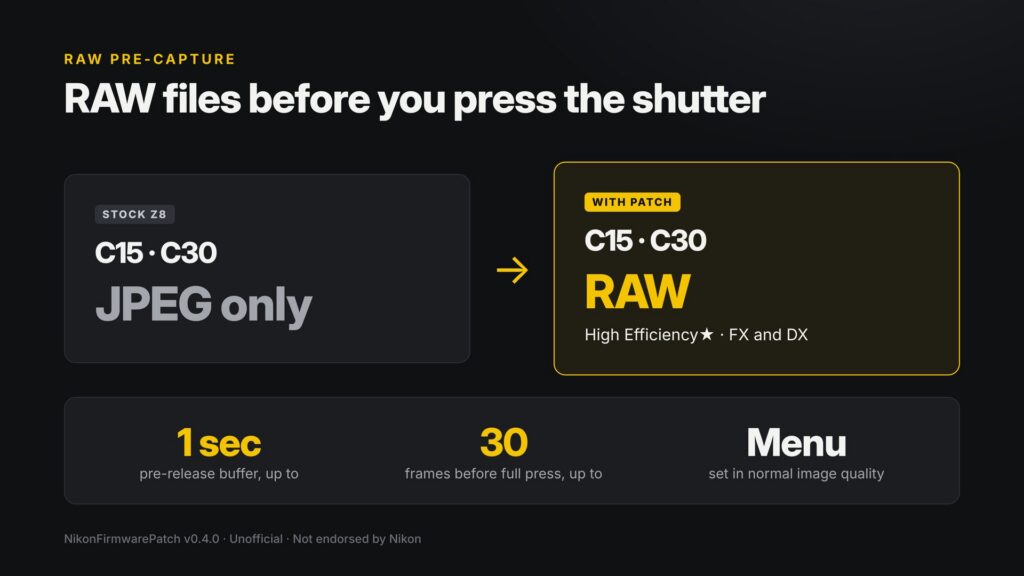
This is the one I wanted most. On a stock Z8, C15 and C30 pre-release capture shoot JPEG only. The patch adds RAW to both, in FX and DX, using High Efficiency★ compression. You choose it through the normal image quality menu.
In my wish list video I said pre-capture was probably never going to give us 14-bit lossless RAW. It would always have to be High Efficiency★, or High Efficiency at a lower burst rate, because of the way pre-capture works on the Z8 and the sheer file sizes involved. That’s exactly where the patch has landed.
It isn’t unlimited. The buffer holds up to around one second, or 30 frames, before you fully press the shutter button. The shots-remaining counter still works out JPEG sizes, so it will overestimate how much space you have left.
In-camera pixel shift merging
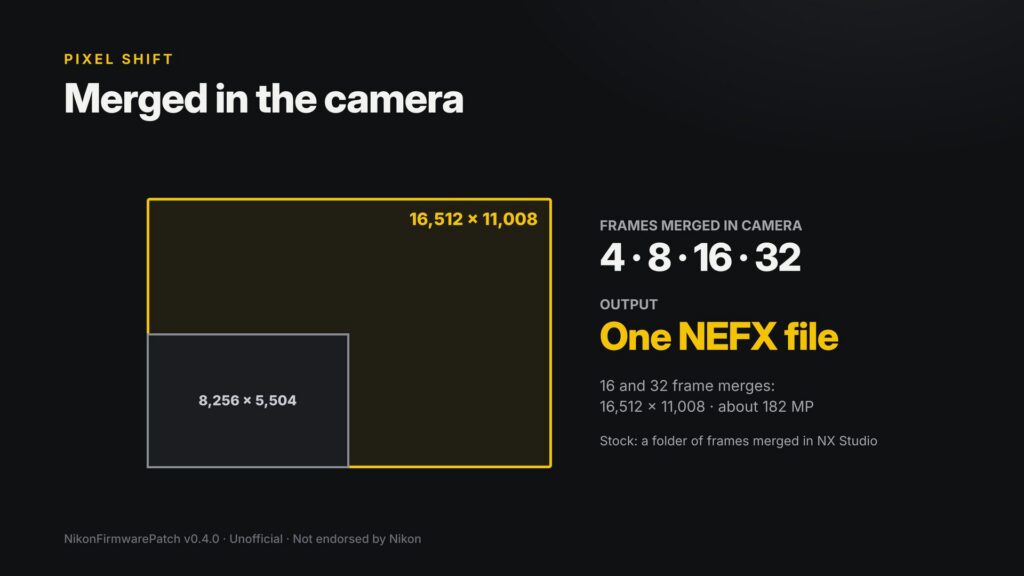
Pixel shift on a stock Z8 means a folder of frames and a trip to NX Studio. The patch merges 4, 8, 16 or 32 frames in the camera into a single NEFX file. The 16 and 32-frame merges come out at 16512 x 11008 pixels.

Know your Z8 inside out, on official firmware
My Z8 Pro Guide app explains every button, menu and setting on your camera, with my recommended setups for every type of photography. It is built around Nikon’s official firmware, so you know exactly how your camera works, and it works fully offline.
Get the Z8 Pro GuideThe risks: you can brick your Z8
This is the part I really want you to read.
The developer says it plainly: this is experimental and can cause lost images, corrupt cards, camera malfunctions or permanent damage. The author of a separate Z8 firmware project has reported that his own Z8 was bricked, and there are reports from other camera hacking projects of bodies that couldn’t be saved.
The risk is real, mainly because testing is still very thin. Every build is checked on a computer and starts in an emulator, but the real-camera testing reported so far is a small sample. The developer’s own readme says offline checks cannot guarantee safe operation on a camera.
What’s missing most is long-term stress testing, the kind that tells you about heat and, more importantly, reliability. Patched firmware could work for a few weeks, or even months, and then hit a glitch. That’s it. You’ve now got yourself a brick.
“I can just go back to Nikon’s firmware”
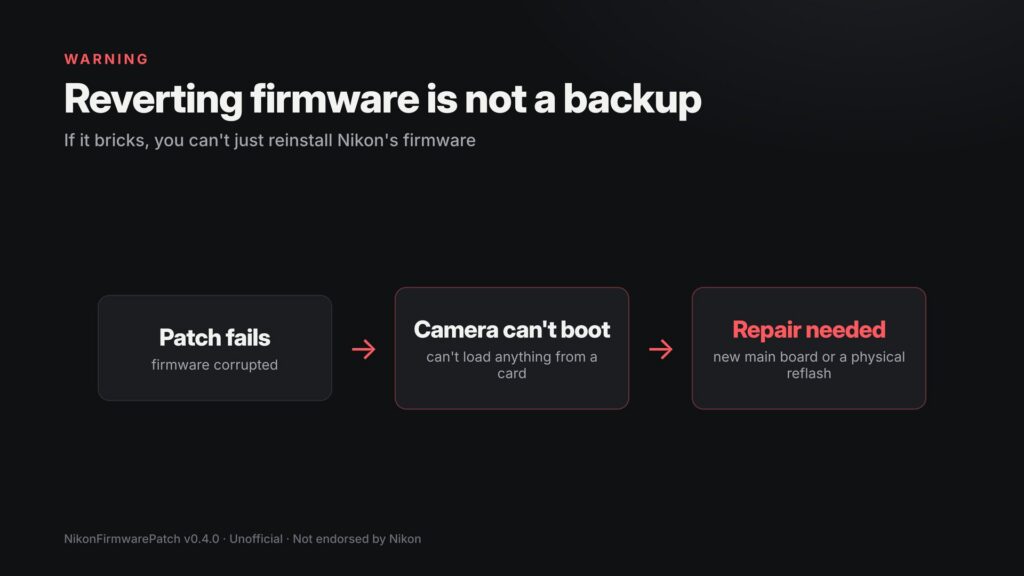
I’ve seen loads of people say this. The Z8 does accept firmware downgrades and reinstalls, so if the camera still boots you can usually put a working version back on. But if the firmware is corrupted badly enough that the camera can’t boot, it can’t load anything from any card. At that point you need a new main board, or for Nikon to physically open the camera and reflash it. Reverting to older firmware is not a real backup.
Heat
The Z8 was never designed to push 8.3K open gate RAW. Nikon didn’t put it there, and part of the reason may well be heat. Please keep that in mind. For more on heat and memory cards in the Z8 on standard firmware, see my Nikon Z8 hot card warning.
Firmware 3.12 and why it matters
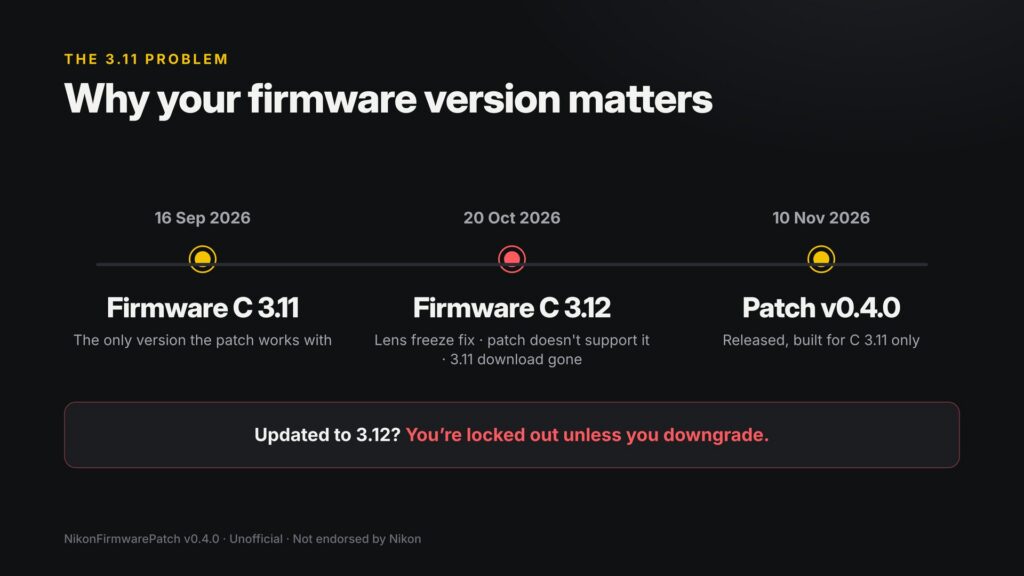
The patch only works with Z8 firmware C 3.11. On 20 October 2026 Nikon released C 3.12, which fixes an issue that could cause the camera to stop responding with some lenses, and C 3.11 is no longer offered for download.
The current patch doesn’t support 3.12, so if your Z8 is already on 3.12 the current builds won’t work for you. Whether that’s a deliberate move by Nikon or just routine housekeeping, nobody outside Nikon can say.
If you just want to keep your Z8 on Nikon’s official firmware, here’s how to update the Nikon Z8 firmware step by step.
Warranty and repairs
Nikon obviously doesn’t support this, and I’m not going to tell you what any service centre will or won’t do. But having worked for years as a camera repair technician in an approved repair centre, I can tell you this sort of thing is very much frowned upon. It would very probably void your warranty. Check before you flash anything.
Then there’s trust. This is AI-assisted code running on a camera that cost you over three grand. AI is brilliant at helping people work faster, but it isn’t the same as a team of Nikon engineers working from the actual source code, which is a 100% accurate map. Vibe coding like this works by trial and error, and I don’t want my camera to be anyone’s error. Do you?
My honest advice
With a lot more testing, this could become exactly what Magic Lantern was for Canon, and I hope that’s where it goes. Some respected voices in the community have said photographers should avoid it altogether. I understand why and I agree, with one change: avoid it for now. Let the developers and researchers do a lot more work on it first.
If the Z8 pays your bills, don’t even dream of installing this. If you’ve got a spare Z8 body, or three grand you genuinely don’t care about, then by all means go ahead and tell us how you get on.
If you want more from your Z8 right now, on official firmware, start with my Nikon Z8 best settings and Z8 autofocus settings guides. You can also compare it with the rest of the range on my Nikon Z cameras page.
What should Nikon do now?
This bit is my opinion, because nobody outside Nikon knows their plan. Here’s what we do know: Nikon has said nothing publicly about these hacks, and the only move so far is firmware 3.12, which happens to lock out the current patched builds. Talking up EXPEED 8 and the next generation doesn’t change things for people who own a Z8 today.
I think Nikon has three options.
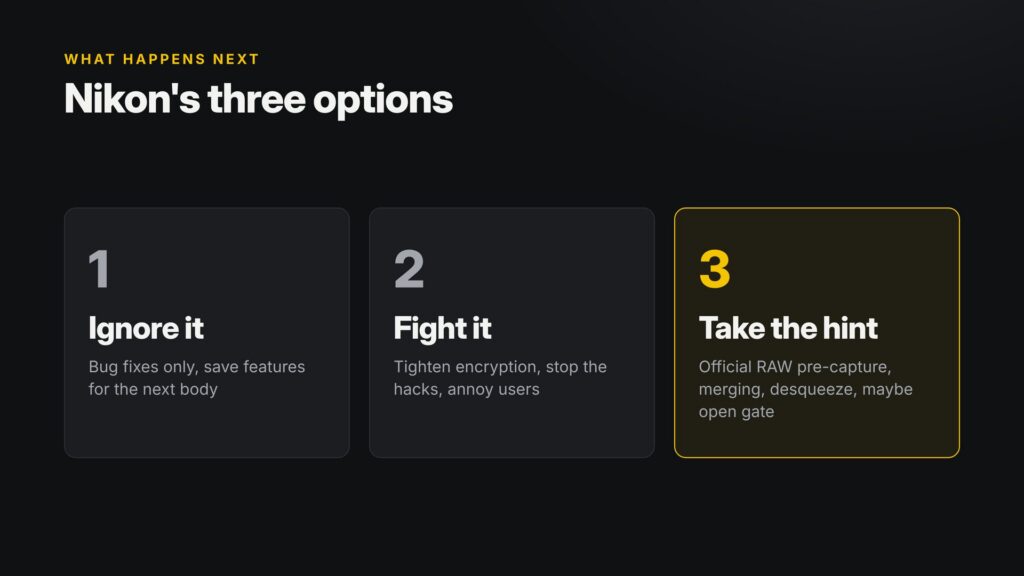
Option one: ignore it. Keep the Z8 on bug fixes and save the big features for the next body. Plenty of people online think the major Z8 updates are over. I’m not one of them, and that’s not what I’m hearing.
Option two: fight it. Tighten the encryption so the hacks stop working. That stops the hack, but it doesn’t address why people want it and it just annoys Nikon users.
Option three: take the hint. Give Z8 owners official RAW pre-capture, in-camera pixel shift merging, anamorphic desqueeze and maybe even open gate if the heat allows, all properly tested with Nikon’s name and research behind it.
Option three is the only one that makes sense to me. If Nikon locks the firmware down, people will simply stop updating. If it ignores this, it loses customers, because these features clearly work and Z8 owners can now see that for themselves. Every month Nikon waits, more people will be tempted to take the risk and some of them will brick their cameras. That’s bad news for owners and even worse news for Nikon. If you bricked your Z8, would you buy another Nikon, or jump ship to Sony or Canon?
Nikon has a great record on firmware. Firmware 2.0 and 3.0 were genuinely big updates for the Z8, and I’m grateful for them. But this is the moment to do the right thing. If you want to see these features officially, make your voice heard: leave a comment on the video telling Nikon what you want in the next update. Alone we’re one voice. Together we’re deafening.
More on the Nikon Z8: Visit my Nikon Z8 hub for all my Z8 articles in one place.
Nikon Z8 firmware hack FAQ
Is the Nikon Z8 firmware hack safe?
Not yet. The developer describes it as experimental and warns it can cause lost images, corrupt cards, malfunctions or permanent damage. Real-camera testing so far is limited and there is no long-term reliability data.
What does NikonFirmwarePatch add to the Z8?
8.3K 3:2 open gate N-RAW at 24, 25 and 30p, anamorphic desqueeze from 1.25x to 2x, Fine and Basic N-RAW levels, ProRes 422, LT and Proxy, lower H.265 bitrates, S-Log3 and RED Log3G10, RAW in C15 and C30 pre-release capture and in-camera pixel shift merging.
Does it work on Z8 firmware 3.12?
No. The current version only works with firmware C 3.11. Nikon released C 3.12 on 20 October 2026 and C 3.11 is no longer available to download from Nikon.
Will installing it void my Nikon warranty?
Nikon does not endorse or support it, and it would very probably void your warranty. Check with Nikon before you install anything.
Can I just go back to the official firmware if something goes wrong?
Only if the camera still boots. The Z8 accepts firmware downgrades, but if the firmware is corrupted so badly that the camera can’t start, it can’t load an update from a card and will need a repair.
Is this like Magic Lantern for Canon?
It could become something similar with a lot more testing. The big difference is that Magic Lantern runs from the memory card, while this patch replaces Nikon’s firmware inside the camera, which is why a failure is more serious.
Does it work on the Z9, Z6III or other Nikon cameras?
NikonFirmwarePatch is for the Z8 only. Other researchers are working on other Nikon bodies, but there’s no comparable ready-to-build patch for them at the time of writing.
- 20 November 2026: First published, alongside my video on the Nikon Z8 firmware hack.